
Itineraries · 9 min · · by Carla Quispe
What to do in Lima: three neighbourhoods worth knowing
Short answer
What is there to do in Lima, Peru?
What to do in Lima depends on how much time you have, from a single day passing through to Cusco to three days built around food. One day covers the historic centre, Miraflores and Barranco with a market lunch. Two or three days add the Larco Museum, a ceviche class or Pachacamac.
What this guide covers
- What to do in Lima in one day, or three
- The historic centre: Lima's UNESCO core
- Miraflores: the clifftop base
- Barranco: Lima's arts district
- What to do in Lima for food
- Getting between the three neighbourhoods
- Is Lima safe? Neighbourhood by neighbourhood
- When to go: the garúa fog season
Key Takeaways
- Lima has three neighbourhoods a first-time visitor needs to know: the historic centre, Miraflores and Barranco. One well-paced day covers all three.
- The historic centre holds Lima’s UNESCO World Heritage listing, first granted in 1988 and extended in 1991.
- Lima’s food scene is not a marketing line: Maido was named the World’s Best Restaurant in 2025, and the World’s 50 Best Restaurants awards return to Lima on 4 November 2026.
- Miraflores and Barranco are where most visitors sleep and where UK and US travel guidance both flag opportunistic theft, not the historic centre.
- The sea fog locals call the garúa turns Lima grey from roughly May to November, which is also the dry, clear season on the other side of the Andes in Cusco.
What to do in Lima in one day, or three
For most trips booked through this site, Lima is where a Peru trip starts and ends. Cusco and Machu Picchu are the reason for the flights in between. That leaves time for one thing: a single, well-organised day.
Lati Travel’s small-group day tour is built for exactly that layover. It runs 8 hours and covers the historic centre, Miraflores, Chorrillos and Barranco. Lunch and entrance fees are included, and it picks up from hotels in Miraflores, San Isidro or Barranco. It is the same ground an independent visitor would try to cover alone, minus the taxi time between districts and the guide who knows which door in the historic centre is worth queuing for.
If Lima is the destination rather than the layover, the shape changes. A second day usually goes to the Larco Museum, a walk through Peruvian ceramics and metalwork, or to a hands-on class like the ceviche cooking workshop. A third goes to Pachacamac, an adobe pyramid complex on the coast south of the city. Lati’s own five-day and six-day Lima packages follow that exact pattern: arrival, a city day, a food day, a museum day, and Pachacamac if there is a fifth day to fill. For the wider country, our Peru tour packages page shows where Lima sits against Cusco, the Sacred Valley and the coast.
The historic centre: Lima’s UNESCO core
Centro Histórico is Lima’s colonial core, built around the Plaza Mayor. It is where the city’s UNESCO status actually sits. UNESCO first inscribed the site in 1988, covering only the Convent of San Francisco. The listing was extended in 1991 to the wider centre, and today the protected area covers about 2.8 km², for its concentration of viceregal-era monuments.
The San Francisco monastery is the single stop worth planning around. Its catacombs, closed as a cemetery in the 19th century and reopened to visitors in 1969, hold human remains stacked in geometric patterns rather than left in disorder, under a library of colonial manuscripts upstairs. Around the Plaza Mayor itself sit the Cathedral, the Government Palace and the Archbishop’s Palace, all walkable in an hour if you are not going inside any of them. A buffer zone stretching a further 8 km² around that core also carries UNESCO protection.
The centre is a working part of the city, not a preserved shell. That means it is also where protests concentrate and where streets can close with little warning. Plan it for daylight hours, and treat it as a half-day, not a base to sleep in.
Miraflores: the clifftop base
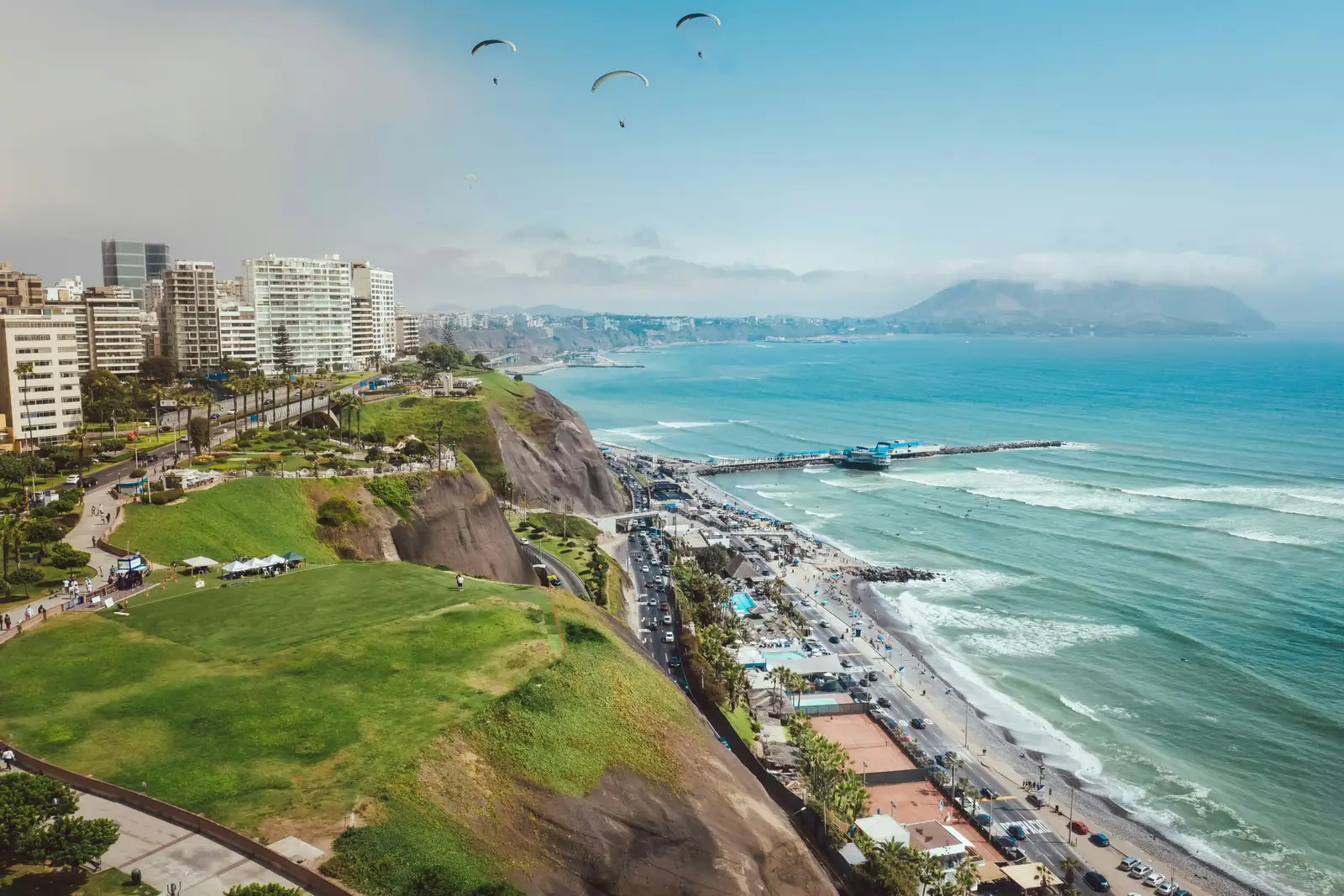
Miraflores sits on cliffs above the Pacific. It is where most international visitors end up sleeping, mostly because it has the highest concentration of hotels, restaurants and tour pickup points in the city. The Malecón runs the length of the clifftop. Parque Kennedy is the social centre of the district, and Parque del Amor looks straight out at the ocean.
It is also the most convenient base logistically. Most Lima day tours, including the small-group tour above, list Miraflores as a pickup point, and it has the most direct routes back to the airport.
Barranco: Lima’s arts district
Barranco sits just south of Miraflores and reads as a different city: cobbled streets, republican-era mansions turned into galleries and boutique hotels, and street murals that change from one visit to the next. The Puente de los Suspiros, a wooden footbridge over a ravine, is the postcard image. The district works just as well as somewhere to walk with no fixed stop in mind.
It is smaller and quieter at night than Miraflores, with fewer hotel options. That is the trade-off for staying there rather than just visiting for an afternoon or an evening.
What to do in Lima for food
Peru’s food scene is not vague praise. It is the specific, current fact that Lima keeps producing winners of the World’s 50 Best Restaurants list. Maido was named the World’s Best Restaurant for 2025, a Nikkei restaurant blending Japanese technique with Peruvian ingredients. Central won the same title in 2023. The World’s 50 Best Restaurants awards return to Lima on 4 November 2026, the first time the ceremony has been held in Peru.
None of that needs a reservation made months out. The everyday version of Lima’s food scene is ceviche: raw fish cured in lime juice, chilli and onion. Peru’s government has treated it as more than a menu item since 2008, when the Ministry of Production declared 28 June National Ceviche Day and named ceviche Cultural Heritage of the Nation. In December 2023, UNESCO went further and inscribed the practices around preparing and eating ceviche on its Representative List of the Intangible Cultural Heritage of Humanity. It is the 12th Peruvian element on that list, and the first tied to food.
The accessible way into that food scene is a market, not a tasting menu. The Lima markets food tour works through stalls in Surquillo and Santiago de Surco, and the ceviche cooking workshop is a two-hour, hands-on version with a pisco sour included.
Getting between the three neighbourhoods
Lima is not one walkable unit the way the historic centre alone is. Miraflores to the historic centre covers roughly 8 to 10 km. Depending on traffic, that takes 25 minutes to over an hour by car or ride app. Barranco to Miraflores is much shorter: a 10 to 15 minute walk or taxi along the clifftop. Ride apps are the practical option for all three legs; agree the fare or confirm the app’s estimate before the car arrives.
Jorge Chávez International Airport sits in Callao, on the opposite side of the city from Miraflores and Barranco. The trip between them typically runs 35 minutes to an hour, depending on the time of day. Build that drive into arrival and departure plans rather than treating it as an afterthought.
Is Lima safe? Neighbourhood by neighbourhood
The UK Foreign, Commonwealth & Development Office is specific about where. It names street crime as a significant problem in Lima generally, and flags Miraflores and Barranco by name as tourist areas where muggings and armed robbery of visitors have occurred. It also warns about fake taxi drivers, particularly around Jorge Chávez airport, and recommends booking transport in advance rather than hailing one on the street.
The US State Department places Peru at Level 2, “Exercise Increased Caution”, the same tier as most of Western Europe. That level is driven by crime rather than a blanket warning against travel. The areas the US advises against entirely are inland border and coca-growing regions, not Lima.
Read together, the two pieces of guidance point the same way. The historic centre’s risk is closures during protests and pickpocketing in crowds. Miraflores and Barranco feel like the safest districts to walk around, yet both are named specifically for opportunistic theft and the occasional armed robbery. Both risks are manageable with the basics: registered transport, no phone out on the street, nothing valuable on show.
When to go: the garúa fog season
Lima runs on the opposite calendar from Cusco. The sea fog locals call the garúa settles over the coast from roughly May to November, at its greyest in July and August, while December to March is the sunnier, warmer window on the coast. That is the same December-to-March period that is the wet season in the Andes, a pattern our best time to visit Peru guide covers region by region.
For a layover before Cusco, Lima’s weather barely matters: a day indoors at a museum or a market works in fog or sun. For a multi-day Lima trip, the sunnier months make the clifftop parks and the Barranco walks better, at the cost of trading away Cusco’s dry season if the same visit continues there.
Before you book
Match the days to the reason you are in Lima. One day, booked as a single small-group tour, covers the historic centre, Miraflores and Barranco without the taxi time of doing it alone. Two or three days turn the same city into a food trip, with the Larco Museum, a market tour or Pachacamac filling the extra time. Either way, book the guided parts in the historic centre and treat Miraflores and Barranco as places to walk with the ordinary caution any large capital city needs.
If Lima is a stop on a longer Peru trip, our guide to Cusco and Machu Picchu without altitude sickness picks up where this one ends, and Huacachina, four hours south along the coast, is the other direction entirely if a desert oasis fits your dates.
Places in this guide
Frequently asked
Is one day enough to see Lima?
For a layover on the way to Cusco, yes. An eight-hour small-group tour covers the historic centre, Miraflores, Chorrillos and Barranco with lunch included, which is the same ground a rushed independent day would cover with more taxi time and no guide.
Should I stay in Miraflores or Barranco?
Miraflores if you want the widest choice of hotels and restaurants and a straightforward taxi to the airport. Barranco if you would rather walk to dinner through a smaller, quieter district and do not mind fewer hotel options.
Is Lima worth two or three days on its own?
Yes, once food is part of the reason you are there. A second day usually goes to the Larco Museum or a cooking class, and a third to Pachacamac or a market tour, which is why Lati's own Lima packages run five to six days rather than one.
Do I need to worry about the historic centre being unsafe?
It is a working city centre with an active police presence, not a district to avoid, but it can be closed off during protests and it is not somewhere to wander after dark without a plan. Miraflores and Barranco are the districts where opportunistic theft against tourists is most documented, not the centre.